

Remember, all people in the U.S., regardless of immigration status, have rights under the U.S. Constitution and other laws. Make sure you know your rights if you are approached by police or ICE. Review the information below to help you understand what your rights are.
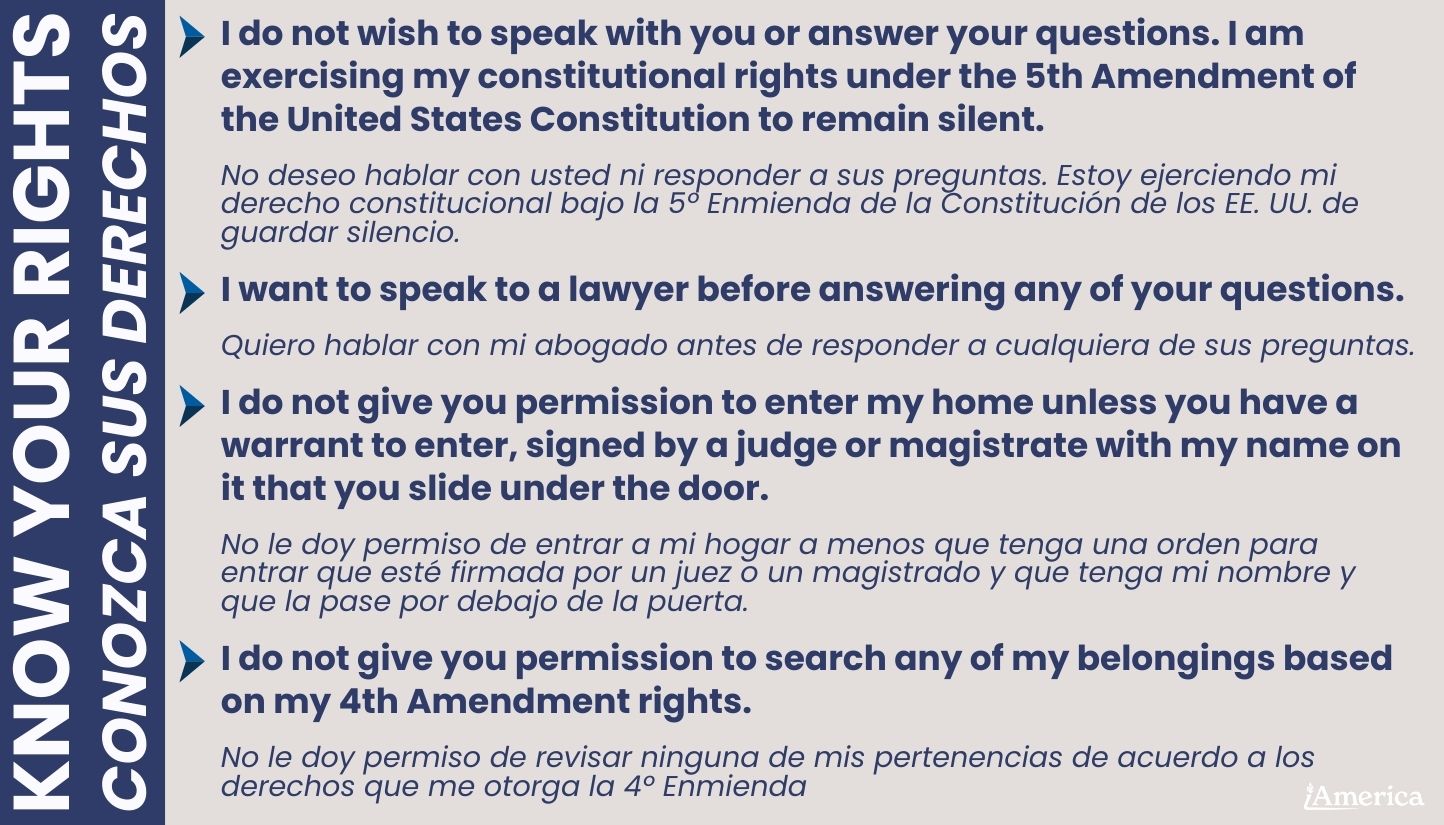
Click through iAmerica‘s helpful infographic above.
What to Do If Immigration Comes to Your Workplace:
Immigration must have a warrant signed by a judge, or the employer’s permission, to enter your workplace. If it is a public place, they do not need a warrant.
THE RIGHT TO REMAIN SILENT:
If you are questioned, it is your right to remain silent and refuse to answer any question. You do not have to give them your name, what country you came from, or your immigration status. If you choose to answer questions, anything you say can be used to try to deport you. If you lie, you can get into serious legal trouble.
If you want to exercise your right to remain silent, an easy way to do that is by showing immigration the Know Your Rights Card linked here.
IMPORTANT!
In some states it is a minor crime not to provide your name when asked by a police officer. While punishment for these crimes is minor, you still could be arrested for not providing your name. Remember that providing your name has risks and that your name can be used to start a deportation process.
DO I HAVE TO GIVE IMMIGRATION MY DOCUMENTS?
Non-citizens are required to present their documents upon request. However, if you chose not to answer any questions, immigration won’t know whether you are a United States citizen or not, and therefore should not take the next step of demanding your documents.
If you provide papers from another country, this may give immigration a reason to question
you more and even a reason to detain you.
If you provide false papers, you are at serious risk not just of deportation, but of criminal
prosecution.
IMPORTANT!
It is possible that immigration may detain workers even if they exercise their right to remain silent. And if workers miss work because they are detained, the employer may decide to fire them. Therefore, workers may choose to answer questions and prove they are documented, which may prevent them from being detained and fired.
CALL FOR HELP:
If you have the opportunity, immediately call your attorney and the Union to tell them what is happening. You may want to designate one worker, such as a Job Steward, to be responsible for calling the Union when a raid happens.
I’m a U.S. Citizen. What Should I do if ICE Questions, Detains, or Arrests Me?
DOES ICE HAVE THE RIGHT TO DETAIN OR ARREST U.S. CITIZENS BASED ON IMMIGRATION STATUS?
NO. The immigration law and its rules do not apply to U.S. citizens. ICE agents have deportation authority over non-citizens only.
ICE agents violate the 4th and 5th Amendment of the Constitution if they question, detain or arrest U.S. citizen based on the citizen’s race.
Tell ICE that you are a U.S. citizen and ICE does not have the authority to detain or arrest you.
Ask to speak to your lawyer. You have the right to speak to your lawyer.
Ask for the ICE agent’s name and badge number and save that information.
Consult a lawyer about filing a lawsuit if you are questioned, detained and arrested. ICE and local police that assist ICE may be liable to pay fines and monetary damages for unlawful, questioning, detention and arrest of U.S. citizens.
The Union is providing you this general information about your rights. Please note, this is not a substitute for legal advice for your particular case, and it does not cover every possible situation. You should talk to a reputable immigration attorney for specific legal advice. Beware of notarios or scammers!